
Indian policymakers are almost alone, alongside the United States, in seeking a hard and multi-sectoral global decoupling from China in the expectation that it will boost their economies, observes Mihir S Sharma.

Fitch Ratings has cut India's economic growth forecast to 8.7 per cent for the current fiscal but raised GDP growth projection for FY23 to 10 per cent, saying the second COVID-19 wave delayed rather than derail the economic recovery. In its APAC Sovereign Credit Overview, Fitch Ratings said India's 'BBB-/Negative' sovereign rating "balances a still-strong medium-term growth outlook and external resilience from solid foreign- reserve buffers, against high public debt, a weak financial sector and some lagging structural factors". The 'Negative' outlook, it said, reflects uncertainty over the debt trajectory following the sharp deterioration in India's public finances due to the pandemic shock.

India's economy continues to be robust, but downside risks such as rising crude oil prices, adverse weather conditions, and the global banking crisis outweigh the upside potential in gross domestic product (GDP) growth in the current financial year (FY24), the finance ministry said on Tuesday in its Monthly Economic Review for March. "We reiterate that downside risks to our official forecast of 6.5 per cent for real GDP growth in FY24 dominate upside risks," the review said. "Opec's surprise production cut has seen oil prices rise in April, off their lows of low-seventies per barrel in March.

Fitch Ratings on Tuesday retained India's economic growth forecast at 7 per cent for the current fiscal, but cut projections for the next two financial years saying the country is not impervious to global developments. In its December edition of the Global Economic Outlook, Fitch projected India's GDP to grow at 7 per cent in the current fiscal, at a slower rate of 6.2 per cent in 2023-24 and at 6.9 per cent in 2024-25. In September, Fitch projected 7 per cent growth for the current fiscal, followed by 6.7 per cent in 2023-24 and 7.1 per cent growth in 2024-25.

Following are the highlights of the Economic Survey 2022-23 tabled in Parliament on Tuesday

Former RBI governor Raghuram Rajan on Tuesday said it is too premature to think that India will replace China when it comes to influencing global economic growth. However, the situation may change going forward as India is already the world's fifth largest economy, it is growing and has the potential to keep expanding. At a World Economic Forum (WEF) press briefing on the recently released Chief Economists Outlook that saw majority of them expecting a global recession in 2023, Rajan said any recovery in the Chinese economy would definitely boost the global growth prospects.

'We should look at is full year's growth rather than quarter numbers.'

Capital markets are becoming more prominent in India's growth story, with an expanding share in capital formation and investment landscape on the back of technology, innovation and digitisation, according to the Economic Survey 2023-24 tabled in Parliament on Monday. Further, Indian markets are resilient to global geo-political and economic shocks, it added. "Despite heightened geo-political risks, rising interest rates and volatile commodity prices, Indian capital markets have been one of the best performing among emerging markets in FY24," the Economic Survey said.

Gita Gopinath, the IMF's Indian-American chief economist has been promoted as its First Deputy Managing Director recognising her exceptional intellectual leadership in helping the global economy and the Fund to navigate the "twists and turns" of the "worst economic crisis of our lives". Gopinath would replace Geoffrey Okamoto who plans to leave the International Monetary Fund early next year, Kristalina Georgieva, IMF's managing director announced on Thursday. Gopinath, who was scheduled to return to her academic position at Harvard University in January 2022, has decided to stay, she said. Gopinath, 49, has served as the first female chief economist of the Washington-based global lender for three years.

Of the seven surveys presented under Modi govt, predictions of three were quite close to the actual GDP growth rate, one saw the base year change in between, but the last three were way off the mark.

'With a solid investment programme and sustainable development strategy, India can exceed 7 per cent growth per year, or a doubling of high-quality national income within a decade.'


India, Asia's third-largest economy, is likely to grow 5.3 per cent in 2013, the OECD said, lower than the November forecast of 5.9 per cent.

Structural reforms, pro-people programmes and employment opportunities helped the economy get new vigour, the finance minister said. After contracting by 5.8 per cent in 2020-21, the economy recorded a growth of 9.1 per cent in 2021-22.

In the first quarter of FY14, real GDP growth estimated by the Central Statistics Office stood at 4.4 per cent on a factor cost basis, and at 2.4 per cent on a market price basis, the IMF said.

The size of Reserve Bank's balance sheet increased by 11.08 per cent to Rs 70.47 lakh crore as on March 2024, leading to the highest-ever dividend payout to the government, according to the central bank's annual report. In actual terms, the increase was Rs 7,02,946.97 crore over Rs 63.45 lakh crore as on March 2023.

The World Bank has retained India's economic growth forecast for the current fiscal at 8.3 per cent as the recovery is yet to become broad-based. As per the first advanced estimates of the national income released by the National Statistical Office (NSO) last week, the economy is projected to grow at 9.2 per cent in 2021-22, surpassing pre-COVID level in actual terms, mainly on account of improved performance, especially in farm, mining and manufacturing sectors. "India's economy is expected to expand by 8.3 per cent in fiscal year 2021/22 (ending March 2022), unchanged from last June's forecast as the recovery is yet to become broad-based.

The simultaneous decline of several trade-related indicators should put policy makers on guard for a sharper slowdown.

The share of foreign loans in total Adani group debt portfolio dropped to 61 per cent by September 2023 from 63 per cent as of March 2023, as the group repaid part of its foreign loans and refinanced part of older loans. The share of Indian lenders, on the other hand, rose to 39 per cent in the total debt pie in September 2023 from 37 per cent in March after a report by US-based short seller Hindenburg Research in January last year, which led to volatility in the share prices of group companies. The group's total debt remained static at Rs 2.26 trillion in the same period.

Economy showing mixed signals, outlook challenging: FinMin

'A 10 to 15 per cent allocation to gold in portfolios reduces risk without compromising on potential returns.'

Digital literacy is emerging as the professional language of 2024. It is the ability to process complex data sets, deploy critical communication technologies appropriately and validate your importance at your workplace, explains Jagdeep Kochar, managing director, Baker & Taylor India.

India's manufacturing sector activity witnessed a significant loss of growth momentum in May due to the intensification of the COVID-19 crisis and its detrimental impact on demand, a monthly survey said on Tuesday. The seasonally adjusted IHS Markit India Manufacturing Purchasing Managers' Index (PMI), fell to 50.8 in May, down from 55.5 in April, as companies observed the slowest rises in new work and output in ten months amid intensification of the COVID-19 crisis. In PMI parlance, a print above 50 means expansion while a score below 50 denotes contraction.

Gold demand appears to be positive in India as the consumer sentiment is likely to recover in 2021, from its dismal performance due to the coronavirus pandemic-related disruptions and volatile price movement, according to a report by the World Gold Council (WGC). Initial data about the Dhanteras festival in November suggest that while jewellery demand was still below average, it had substantially recovered from the lows seen in the second quarter (April-June 2020) of last year, according to the report.

Global rating agency Moody's on Monday raised India's growth forecast for 2024 calendar year to 6.8 per cent, from 6.1 per cent estimated earlier, on the back of 'stronger-than-expected' economic data of 2023 and fading global economic headwinds. India's real GDP expanded 8.4 per cent year-over-year in the fourth quarter of calendar year 2023, resulting in a 7.7 per cent growth for full-year 2023. Capital spending by the government and strong manufacturing activity have meaningfully contributed to the robust growth outcomes in 2023, Moody's Investors Service said.
The patriotism of wealthy overseas Indians has helped the country avert economic crises in the past and it is little surprise that embattled policymakers are turning to them again to plug a record trade gap that is battering the rupee.

The temporary disruptions (primarily to private consumption) caused by cash shortages accompanying the currency exchange initiative are expected to gradually dissipate in 2017 as cash shortages ease, the International Monetary Fund said in its regional economic outlook.

Although the first woman to hold the position of chief economist at IMF, it would be wrong to see her appointment through the lens of gender
Industry body CII on Thursday made a case for pushing reforms in sectors like land, labour, and agriculture by the Modi 3.0 government to accelerate economic growth, which is estimated to be around 8 per cent in the current financial year. CII president Sanjiv Puri said a lot of policy interventions in the past have put the economy on "a much stronger wicket". "The growth rate is poised to touch 8 per cent during the current year, marking the fourth consecutive year of above 7 per cent + growth.

India's services sector growth eased slightly in April but growth of new business and output remained sharp and among the fastest in 14 years amid favourable economic conditions and strong demand, a monthly survey said on Monday. The seasonally adjusted HSBC India Services Business Activity Index fell from 61.2 in March to 60.8 in April, highlighting one of the strongest growth rates seen in just under 14 years. Survey members attributed the latest upturn in output to favourable economic conditions, demand strength and rising intakes of new work.

'We expect a pick-up in the second half of the current fiscal. But before that, data is likely to show a further slowdown. The second quarter print is likely to be worse than the first quarter,' said a senior official.

The IMF said global growth is projected to reach 3.9 per cent in 2018 and 2019, in line with the forecast of the April 2018 WEO, but the expansion is becoming less even, and risks to the outlook are mounting.
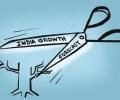
Fitch Ratings on Thursday slashed India's GDP growth projection for FY23 to 7 per cent, saying the economy is expected to slow against the backdrop of global economy, elevated inflation and high interest rate. In June, it had forecast 7.8 per cent growth for India. "We expect the economy to slow given the global economic backdrop, elevated inflation and tighter monetary policy. "We now expect the economy to grow 7 per cent in the financial year to end-March 2023 (FY23) from 7.8 per cent previously, with FY24 also slowing to 6.7 per cent from 7.4 per cent before," Fitch said in its September edition of the Global Economic Outlook.

Christine Lagarde said the prospect of rising interest rates in the US and China's slowdown are contributing to uncertainty and higher market volatility.

Germany is now sitting on a mountain of savings.

Other top losers in the Sensex pack included Bharti Airtel, Asian Paints, TCS, HCL Tech, Tata Steel, SBI, IndusInd Bank and Hero MotoCorp, declining up to 3.28 per cent.

India's merchandise exports rose by 9.1 per cent to $38.13 billion in May even as the trade deficit widened to a seven-month high of $23.78 billion during the month, according to government data. Healthy growth in sectors, such as engineering, electronics, pharmaceuticals, textiles and plastics helped register growth in exports despite global economic uncertainties.

After raising interest rate by a cumulative 250 basis points in 11 months, the Reserve Bank of India (RBI) on Thursday unexpectedly kept benchmark rate unchanged as global banking woes added uncertainty to the economic outlook. Five out of six members of MPC voted to remain focused on the withdrawal of accommodation to ensure inflation aligns with target while focusing on growth, RBI Governor Shaktikanta Das said on Thursday. The Monetary Policy Committee of the central bank decided to take a pause after a rate hike seen in previous six consecutive policies.

Amid rising geopolitical risks, a vast majority of Indian CEOs have indicated in a survey that they are reducing or planning to reduce operating costs, even as they are more upbeat than their global peers on their country's economic prospects. However, most of the companies do not plan to cut their headcount or salaries, found the annual Global CEO Survey released by consultancy giant PwC here on the first day of the World Economic Forum meeting on Monday. The survey also found that about four in ten CEOs (40 per cent of global and 41 per cent of India respondents) do not expect their companies to be economically viable in 10 years if they continue on their current path.

'With India's growing capabilities in the space sector, this creates promising opportunities for enhanced collaboration and market access.'
